UW graduate capstone (solo after month two) asking whether people could be equipped to identify misinformation themselves, in research partnership with TrueMedia.org.
Constraint
No engineering resourcing beyond a prototype, and testing showed users rejected any platform-integrated solution outright — the tool had to stand alone.
Decision
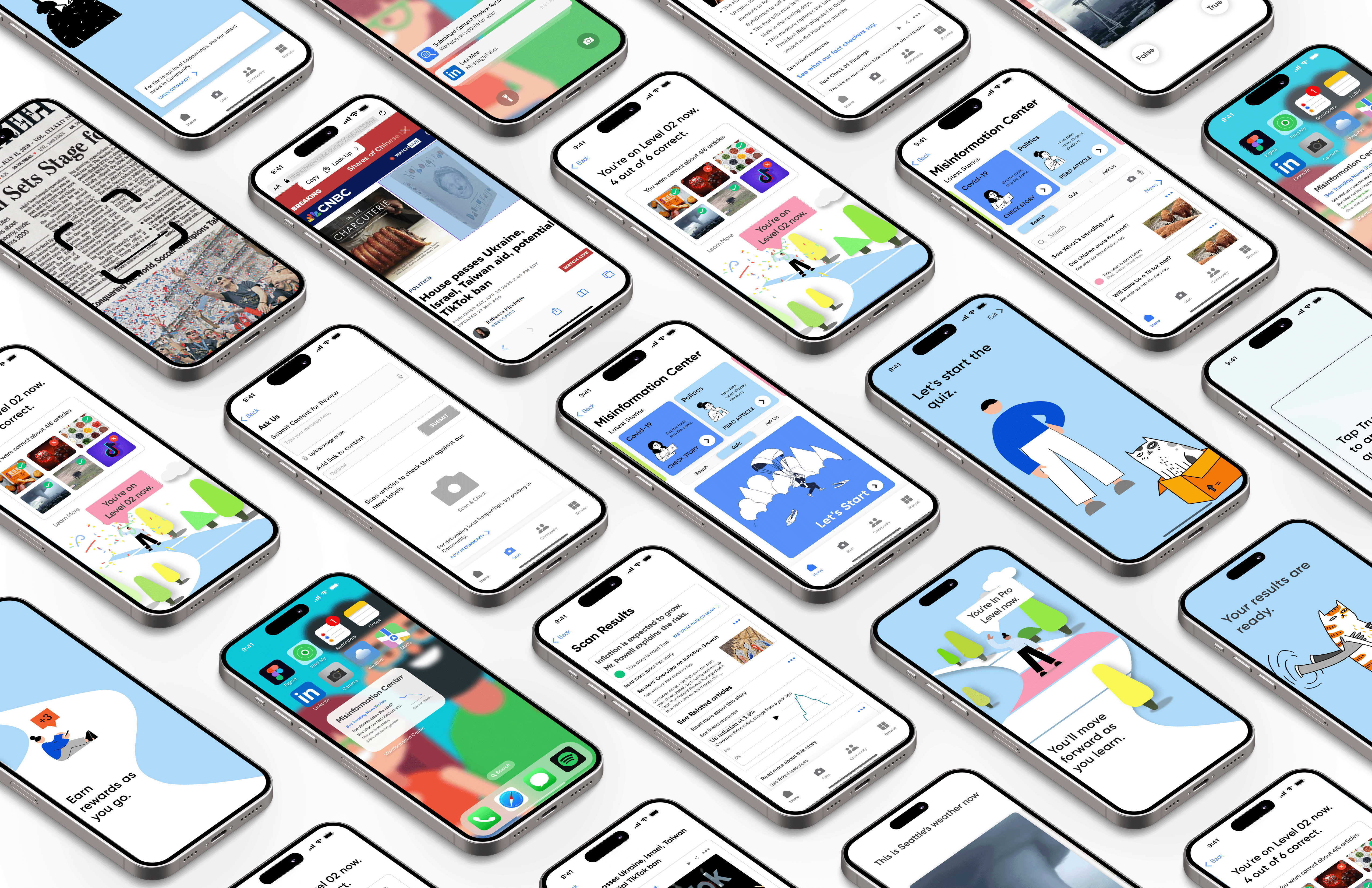
Built four independent tools (Search, Scan, Quiz, Ask Us) that help people verify and learn, instead of another fact-check label.
Tradeoff
Concept validated with ~1,800 testers, but TrueMedia shut down mid-collaboration — proof that sound design alone can't make a public good sustainable.
TL;DR
Role
Sole Designer (Graduate Capstone)
Team
Solo (post-February 2024) · Research collaboration with TrueMedia.org
Timeline
12 months (Jan–Dec 2024)
Impact
~1,800 testers at Misinfo Day | 2,000-respondent survey | Concept validation
Key Skills
User research · Concept design · Gamification · Platform strategy · Academic rigor
01 — Snapshot
Headline result
Two hours of searching became a few minutes of checking.
2h → 5m
Four participants at different life stages described spending around two hours verifying a claim on their own. In testing, they reached the same answer in about five minutes — baseline self-reported, outcome observed in session.
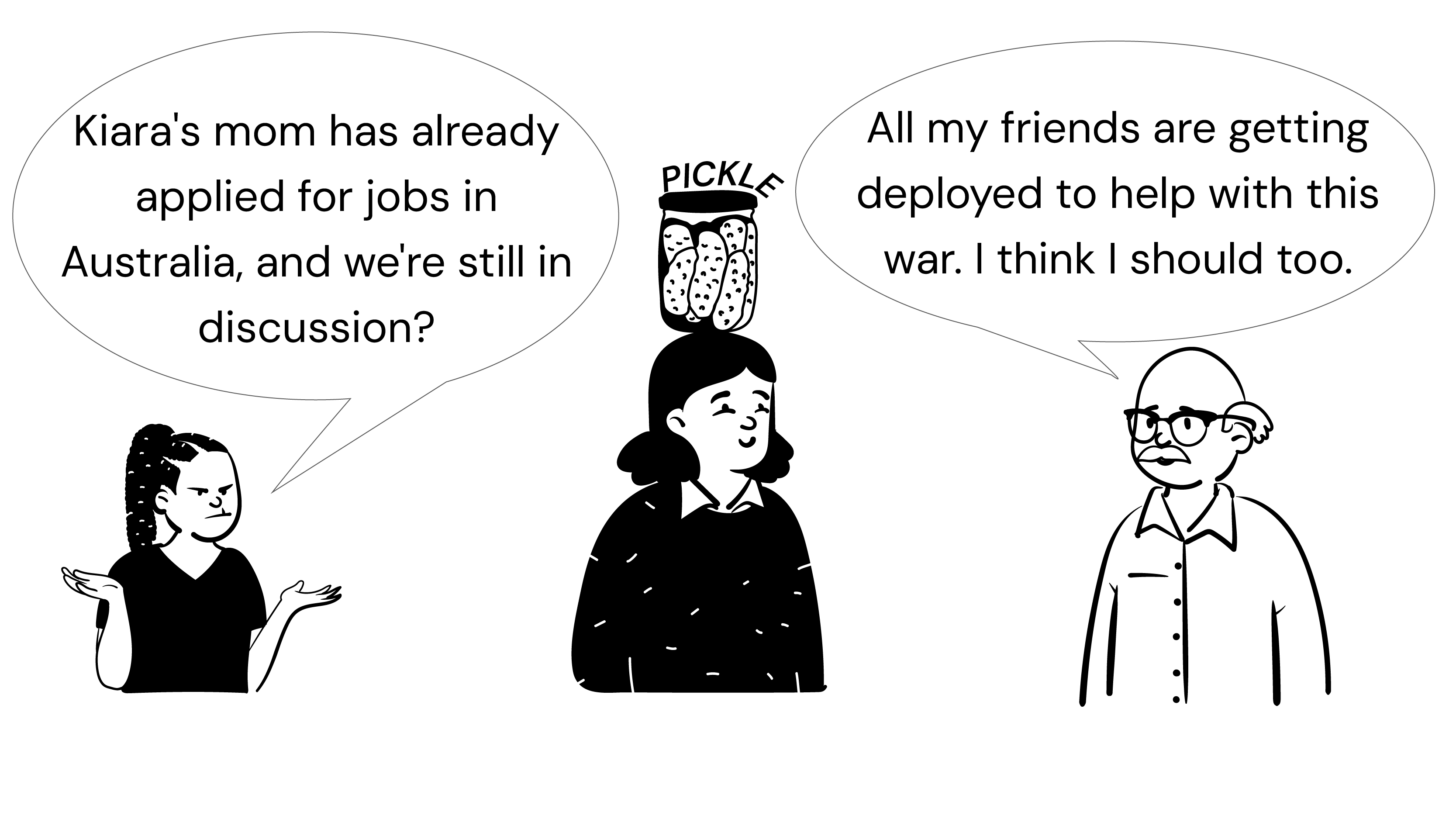
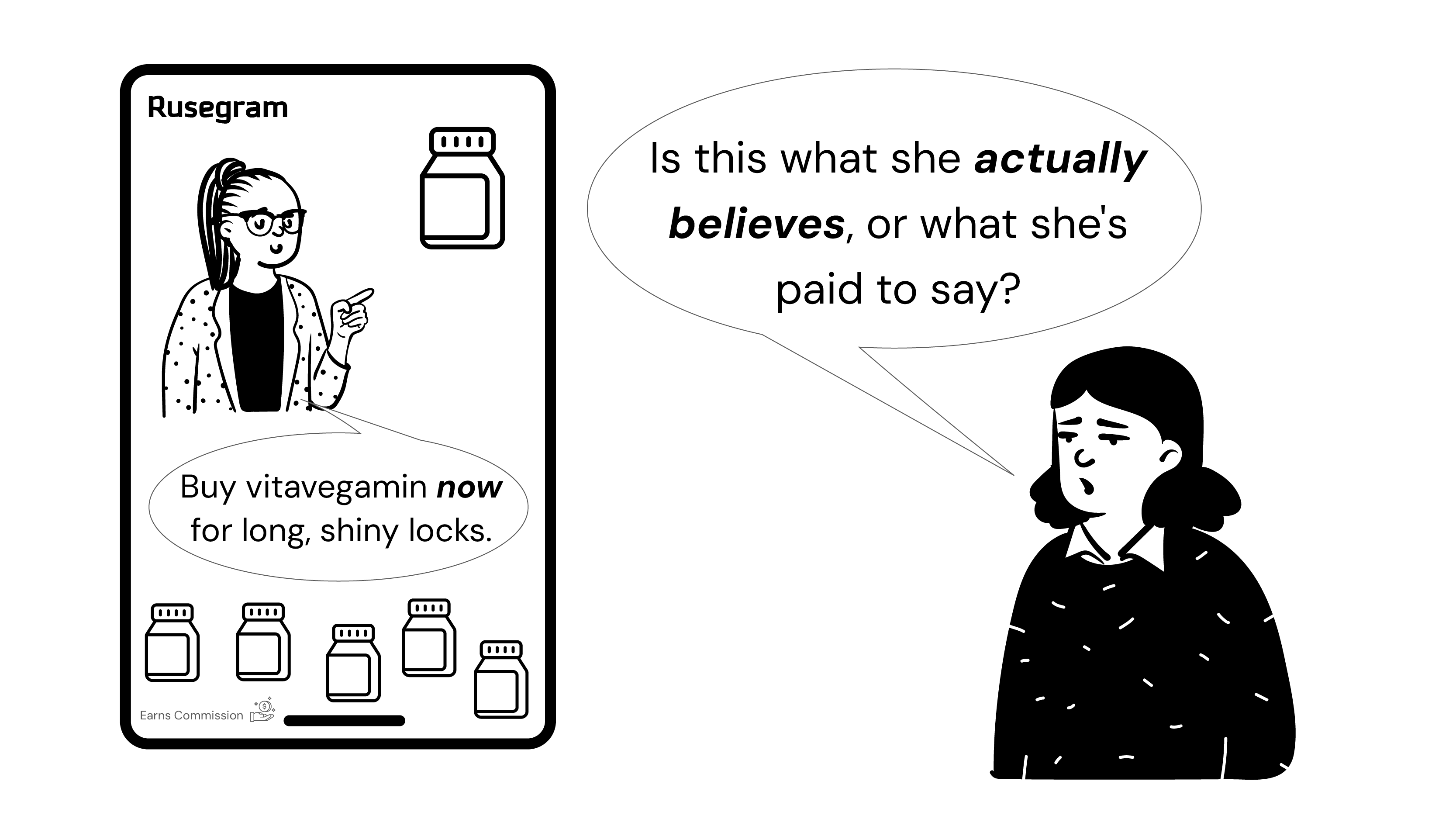
Platforms try to control misinformation, but users don't trust them. This capstone asked a different question: what if we equipped people to identify it themselves?
Agency over authority. People resist being told what's true, but respond well to tools that help them decide for themselves — not another fact-check label.
My role. Sole designer on this UW graduate capstone (Jan–Dec 2024), started as a team of four. After February, the research, archetypes, all four features, and testing with ~1,800 people at Misinfo Day were mine alone.
From March to May, I also collaborated with TrueMedia.org, a deepfake-detection nonprofit. They analyzed 60,000+ pieces of media and shut down in January 2025 — not from bad design, but because nobody profits from detection. That's this case study's throughline (section 06).
Search & Image Search
Verify links, headlines, and images with layered credibility ratings
Scan
Camera-based verification for printed content — flyers, newspapers, ads
Literacy Quiz
A level-based game teaching users to spot manipulated content
Ask Us
Human-backed fact-checking for gray-area content algorithms miss
2,000
survey respondents
28
interview participants, two phases
14
moderated usability participants
~1,800
tested live at Misinfo Day
02 — The Problem
After AI, the same problem arrived at a different scale
Misinformation exploits human bias: believe what confirms your views, share before verifying. After AI, the same problem arrived at a different scale — more believable, more volume, same fragile ecosystem.
Survey Results (n=2,000)
74% encountered misinformation weekly, 62% of parents felt overwhelmed, and <20% trusted existing fact-checkers.
The Generational Sandwich
Mothers filtering misinformation for kids while protecting elderly parents from scams — shaped the archetype strategy.
The Transparency Demand
Users wanted to see who benefits from content, not just a fact-check label.
The Platform Trust Problem
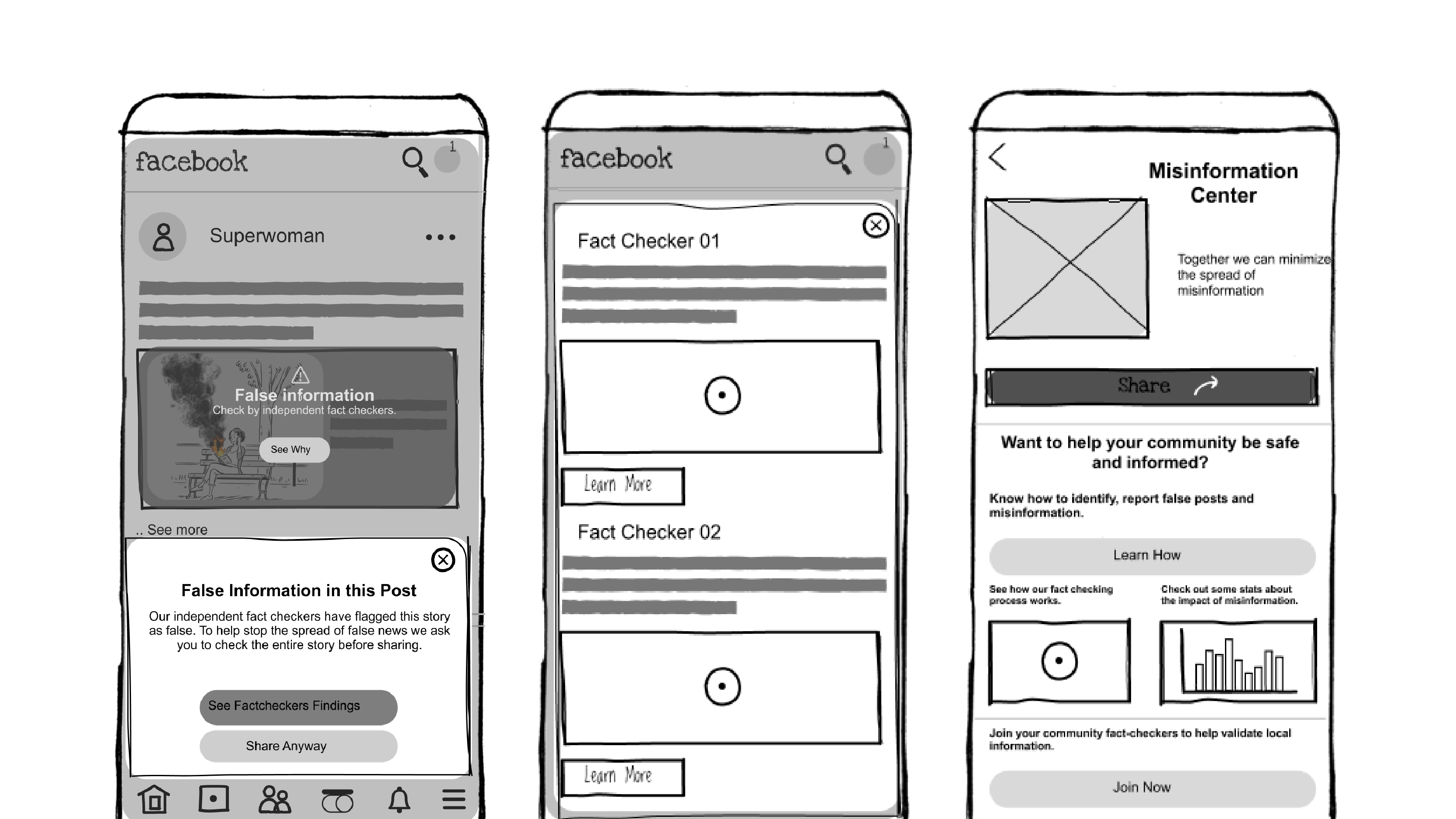
Testing rejected a solution integrated into a major social platform immediately — the tool had to stand independent.
The platform that spread the problem was structurally incapable of being trusted as its solution.
The quiz builds the skill, Search and Scan provide the tool at the moment of need, Ask Us is the human fallback at the tool's limit
Each feature came from a specific gap the research exposed — not a feature list.
The pivot: from platform-embedded to standalone
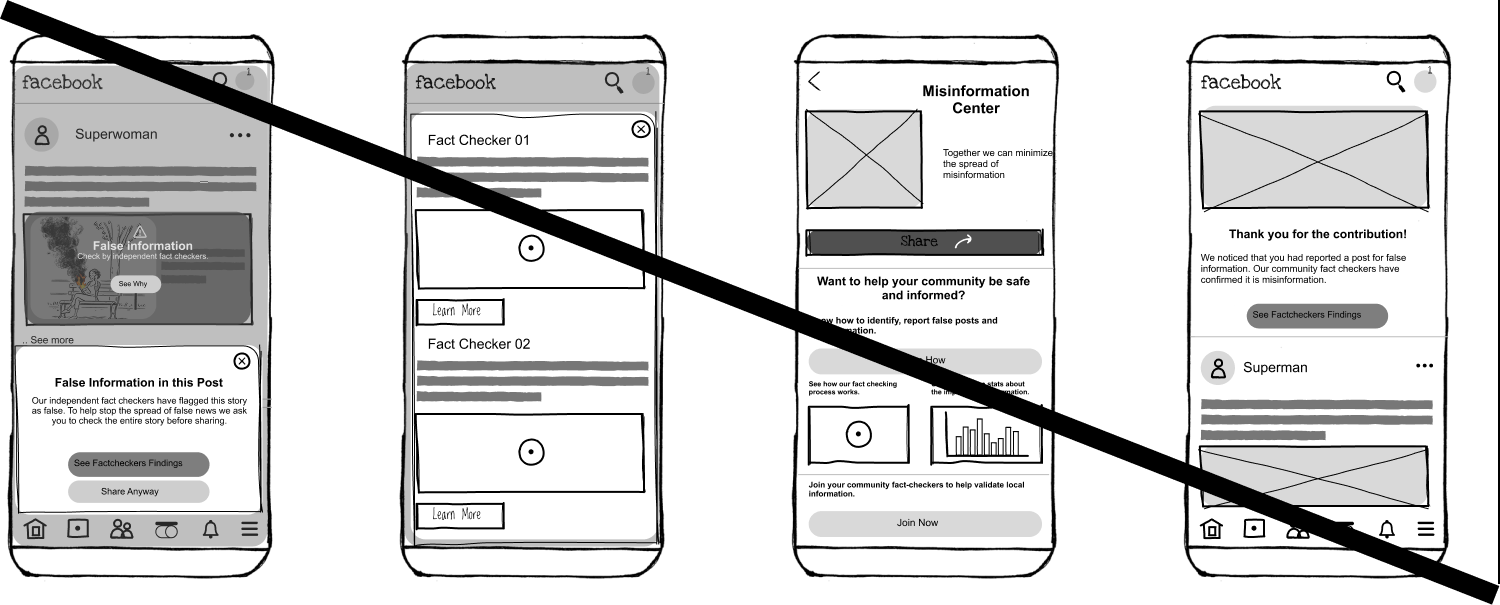
Before any interface work, I'd already concluded a standalone public-interest tool couldn't fund itself — so the first iteration met people where the infrastructure and users already existed: a Misinformation Center embedded in a major social platform, with fact-check labels, community reporting, a hub in the feed. Dead on arrival for two independent reasons: users wouldn't trust the platform spreading misinformation to also solve it, and that platform's own base skews older, missing the audience most active in verification. That reopened the exact funding question I'd tried to design around, and I sat stuck on it for weeks while teammates moved to easier scopes — a Snopes-style news app, a game, a city website redesign.
Feature 01 — Literacy Quiz
Tutorials and explainers weren't changing behavior — early "how to spot misinformation" modules had users disengaging like it was homework. The first quiz format, read a claim and type a response, lost users by question four.
The constraint became the feature:
Under 40 seconds per session
One hand, on a train
Real social media content (not sanitized examples)
Swipe-based True/False interaction
Try it yourself ↓
Question 1 of 5
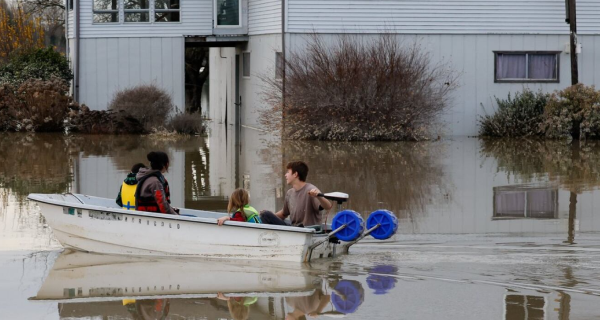
This photo shows recent flooding in Seattle caused by climate change.
The quiz was designed in the visual register of the platforms where misinformation actually spreads, not the register of an educational tool.
After Misinfo Day, completion states were redesigned around skill progression rather than score — "You're getting better at spotting this" outperformed a percentage. Users also wanted to know why an item was false, which conflicted with the 40-second constraint; the resolution was speed for the question, depth for the reveal, sources one tap away.
Feature 02 — Search & Image Search
Verification had to come to users, not the reverse — one entry point for both links and images.
Four states, not two
True, Misleading, False, Satire. Misleading was critical: most misinformation isn't false, it's selectively true.
Badge + evidence
Fast badge upfront, one tap to reveal sources and reasoning — users wanted the why, not just the verdict.
Multiple sources
Reuters, AP, a fact-check org side by side — institutional backing users could verify themselves.
Feature 03 — Scan
Scan came from Misinfo Day: what happens when the misinformation is a printed flyer, a newspaper, a poster? Older users hesitated and erred on forms, but scanned instantly — a behavior already learned from restaurant QR codes.
Feature 04 — Ask Us
Some misinformation exists in no database — private WhatsApp forwards, local rumors, freshly manipulated images. Automated systems can't catch what they've never seen, and users who distrusted platform verdicts wouldn't trust an AI verdict either.
Human judgment backed by journalistic expertise was the only answer.
Clear response-time expectations
Pending / Under Review / Responded, so users knew what to expect.
Three-step simplification
After Misinfo Day, the multi-field form dropped to three steps — older participants were struggling with entry.
The quiz builds the skill, Search and Scan provide the tool at the moment of need, Ask Us is the human fallback at the tool's limit. None of them tell users what to think.
"The prototype is very well crafted… the experience looks easy and also fun."
— capstone reviewer
Let's get into the details now.
04 — Testing & Validation
The first version didn't fail on usability. It failed on who was asking.
Three rounds before the four tools settled — a platform-embedded concept, a format head-to-head, and the full build at the capstone showcase.
What testing disproved. Seventeen of nineteen people wouldn't engage with a version built inside a major social platform — they kept asking why it was there. Not a design problem; no interface would have fixed it. So I moved it out.
What testing confirmed. People skimmed the written guide but finished the interactive quiz, so the quiz became the backbone. At the showcase the flow held without help, with one gap: no exit from every screen.
17/19
wouldn't engage with the platform-embedded concept
2
formats tested head-to-head: written guide vs. interactive quiz
2h → 5m
verification time, participant-reported
05 — Market Research
Verification had to live where misinformation spreads, but platform ownership destroyed trust
Snopes is monetized; the free alternatives are nonprofits with text-heavy resources people ignore — two categories, neither worked:
Monetized Platforms — Credible but Compromised
Snopes had trust, but ran ads. Platform labels and Community Notes had scale but read as biased.
Nonprofit Resources — Trustworthy but Invisible
Literacy initiatives had integrity but no engagement in a short-form-video era.
The gap: users trusted established outlets, wanted multiple sources, inside apps they already used — leaving was fatal friction.
Verification had to live where misinformation spreads, but platform ownership destroyed trust.
The integration insight. I brought this to all three professors — none engaged, waving it off as digging too deep. I worked it through instead with my husband, an AI scientist outside product: a trusted utility in trusted surfaces — Safari share sheet, Apple News, native camera — backed by verifiable institutions, owned by none of the platforms it lives in.
"Great idea to bring in UI scenarios outside of the app itself, like the lock screen widget."
— capstone reviewer
06 — User Research
Misinformation moves through trust networks — families, WhatsApp groups, neighborhood pages — in a specific generational pattern
Early testing — verify a headline in under 30 seconds — surfaced ambiguous labels and slow search, shaping the shift to color-coded ratings.
Misinformation moves through trust networks — families, WhatsApp groups, neighborhood pages — in a specific generational pattern.
The finding that changed the problem: families argue over what's true, and it runs through specific channels: adults 55–80 scammed via WhatsApp groups from trusted contacts, teens 13–18 pressured into exposing personal data, and 25–40 caught managing both.
The archetypes emerged from that chain:
Truth Seekers (18–30)
Already motivated, cross-referencing sources, want to be validators.
Overwhelmed Guardians (25–40)
Want verification tools, but any friction loses this group.
Vulnerable Believers (55–80)
Trust what comes from people they know — design means meeting existing behavior.
The strategy: design for the first two — they become the human layer protecting the third, like a mother who verifies before forwarding to her parent.
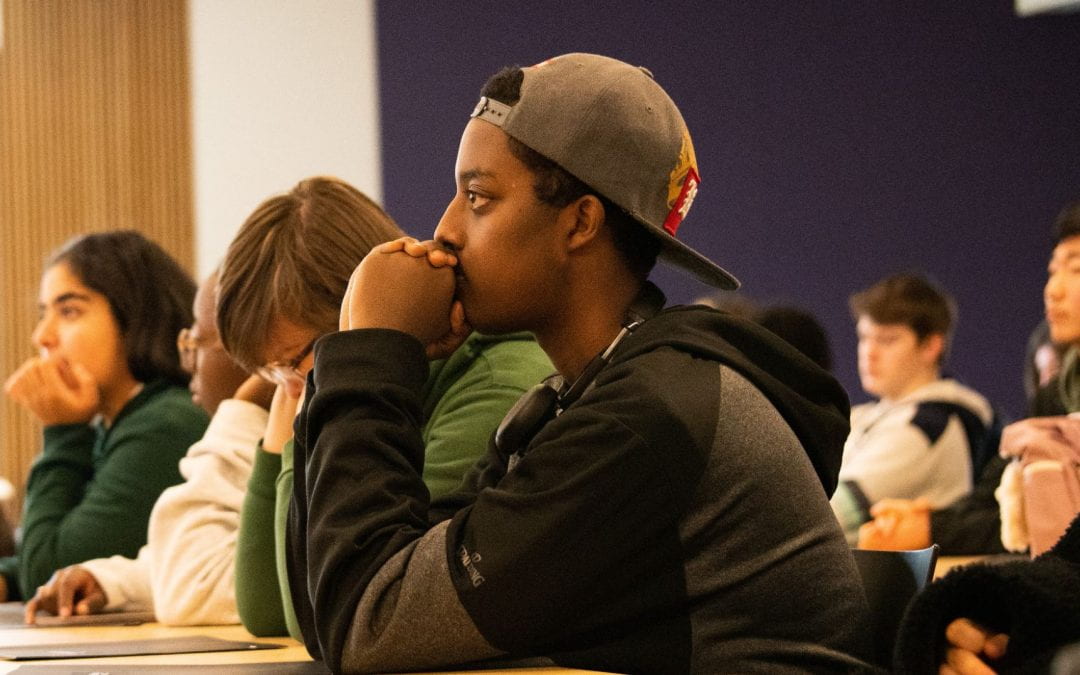
What Misinfo Day revealed that recruited testing couldn't. Live crowds show what people do, not what they say. Younger participants abandoned anything that felt like reading within seconds; older participants trusted Ask Us over automated ratings. Engagement spiked when detection was framed as a skill, not a correction.
This was also when Scan got decided — attendees wanted to check something in front of them right now, not just what was on their phone.
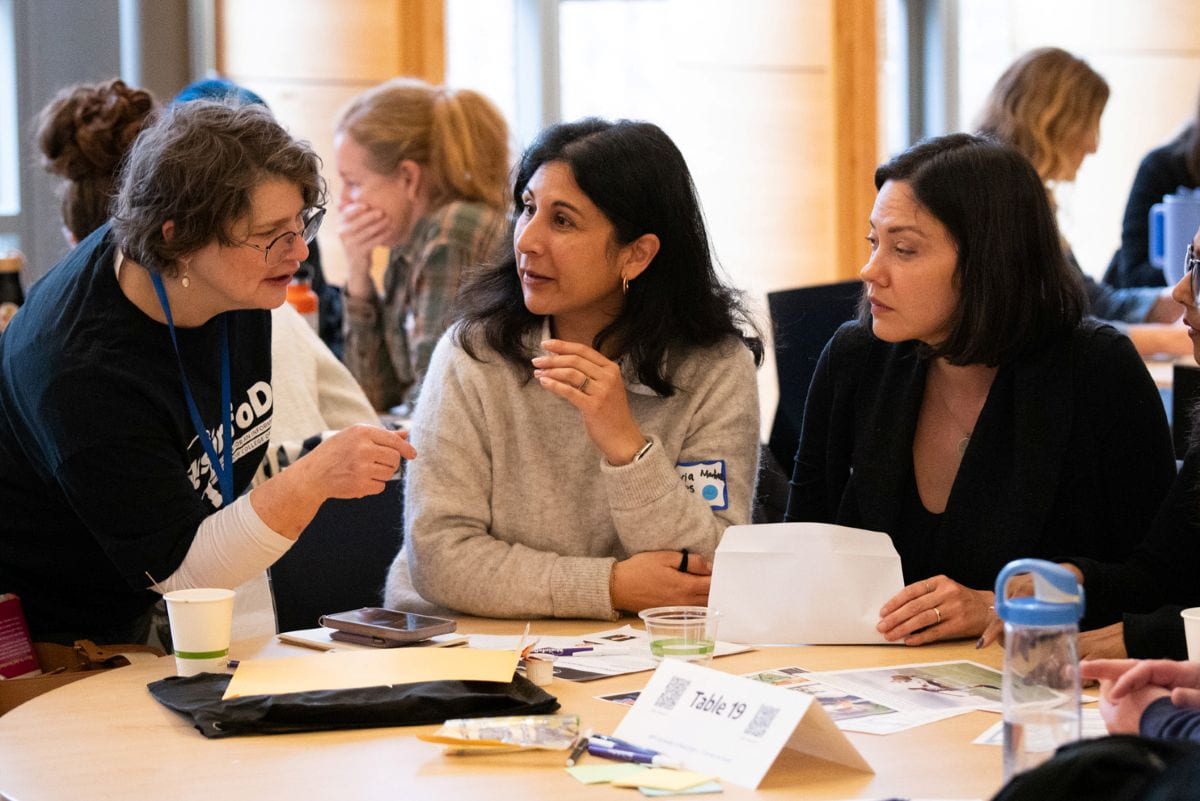
Misinfo Day — live testing with ~1,800 participants
07 — Impact & Results
96% of 36 Gen Z and millennial testers said they'd use it. Older users needed a camera first.
Younger testers took to search and the quiz immediately. Older participants stayed out until Scan arrived — pointing a camera at a newspaper asked nothing of them they didn't already know, and it removed the part they disliked most: having to ask a younger relative for help.
96%
of 36 Gen Z and millennial testers said they'd use it
2h → 5m
verification they described as taking two hours took about five minutes in testing
The final version was framed as a system utility — something that lives beside the compass and the calculator, not an app you remember to open.
08 — TrueMedia
Detection is the expensive end of the chain — authenticating content at creation is fundamentally more efficient, but nobody profits from implementing it
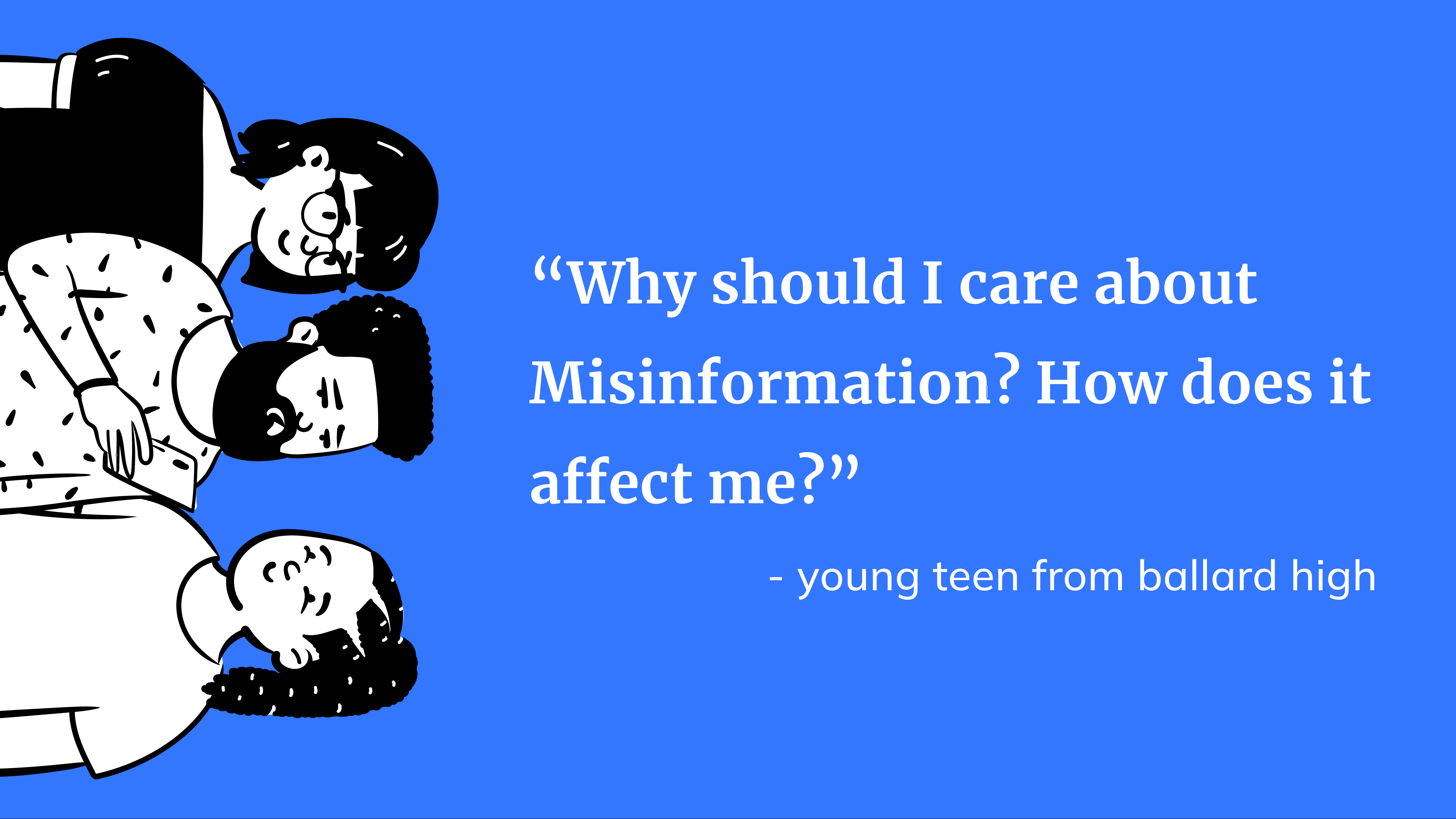
TrueMedia.org was a nonprofit building deepfake detection for the 2024 election. Through UW's partnership, I contributed research synthesis on what to prioritize. They shipped a dark, utilitarian tool for journalists; mine served a teenager asking "why should I care?" — two solutions to adjacent problems. Per later reporting on the shutdown, they analyzed 60,000+ pieces of media, launched in September 2024, and shut down in January 2025, open-sourcing the technology rather than chasing funding. Founder Oren Etzioni, quoted in that coverage: "We are not prepared for a large-scale, generative AI attack. It hasn't come yet. That doesn't mean it won't."
TrueMedia's Head of Product reframed the market for me in two lessons: platforms are ambivalent about detection because it drives engagement, and the real unaddressed threat — personalized scams — never reaches a community to verify it. His critique: detection is the expensive end of the chain; authenticating content at creation is more efficient, but C2PA proposed exactly that and stalled on incentives.
A designer who thinks only about what users see is a UI designer. A designer who thinks about everything required to make that experience real and sustainable is a product leader
What this project taught me. Design alone can't make a public good sustainable — TrueMedia was research-grounded and mission-complete, yet closed on economics, not design. The integration vision, embedded in trusted surfaces with no business model, is the answer. A designer who only sees the UI misses that; a product leader thinks about what makes it real.
What changed. Feedback pushed the quiz to teach the why behind each answer, and credibility badges toward layered reveals — signal first, reasoning a tap away. By 2026, AI collapses the staffing this needed; the design question is answered, the ecosystem question isn't.
"Demo was very well designed. Excited to see the next steps."